Quick Summary: A cramped closet is a sign of a cramped mind. Transitioning to a “Breathing Closet” isn’t about having fewer clothes; it’s about changing how they live together. By using the “Uniform Hanger” rule and the “Negative Space” principle, you can turn your morning routine from a struggle into a sanctuary.
The Morning Friction
We’ve all felt it: that heavy sigh when you open your closet doors at 7:00 AM. You have plenty of clothes, yet you feel like you have nothing to wear. You’re fighting through a dense forest of mismatched hangers and tangled sleeves, just to find one clean shirt.
At NeatlyUp, we believe the problem isn’t the size of your closet—it’s the friction. When your clothes are packed so tightly they can’t breathe, neither can you.
The Counter-Intuitive Truth: “Negative Space” is a Luxury
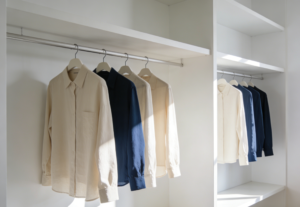
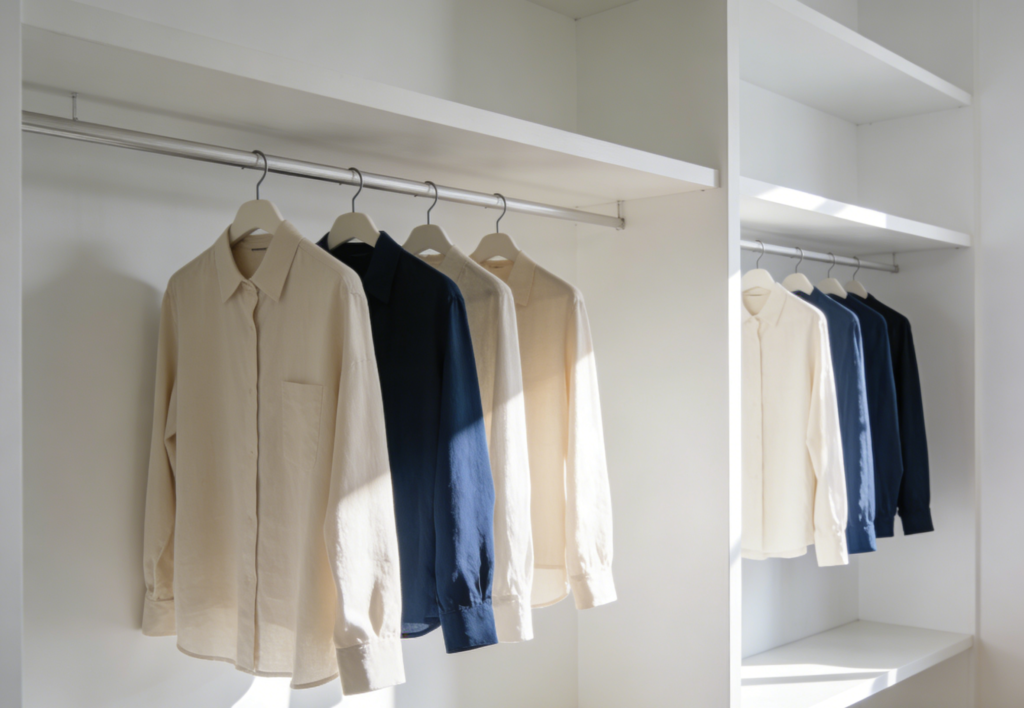
Most people think a “good” closet is one that utilizes every inch of space. We disagree. The ultimate luxury in home organization is empty space. Imagine a closet where you can slide a hanger from left to right without hitting another garment. That “slide” is a sensory cue to your brain that life is under control. When you leave 10% of your hanging rod empty, you aren’t “wasting” space; you are investing in your morning peace.
3 Steps to a Breathing Closet
1. The “Uniform Hanger” Rule (The Only Investment Needed)
If you do buy one thing, let it be a set of matching hangers.
- The Psychology: When your hangers are a chaotic mix of plastic, wire, and wood, your brain has to process all those different shapes and heights.
- The Result: When they match, the hangers “disappear,” and your clothes suddenly look like a curated boutique. It creates instant visual silence.
2. The “Hand-Width” Gap
Try this tomorrow: Remove five items you haven’t worn in a year. Use the reclaimed space to create a “hand-width” gap between your remaining clothes.
- Sensory Check: Listen to the sound of the fabric. In a crowded closet, clothes make a muffled, heavy sound. In a Breathing Closet, you hear the light swish of air moving between them.
3. Organize by “Weight,” Not Just Color
Instead of just color-coding, try organizing by the “weight” of the fabric.
- The Flow: Start with your lightest linens and silks on the left, moving toward heavy knits and wools on the right.
- Why it works: It mimics the natural flow of the seasons and makes your closet feel physically balanced.
Pro-Tips for Small Wardrobes
- The Reverse Hanger Trick: Turn all your hangers backward. When you wear an item, put it back with the hanger facing forward. After six months, anything still facing backward is a candidate for the trash bag.
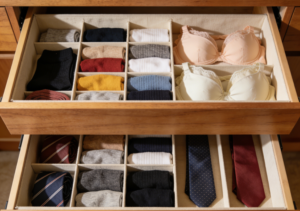
- Shoeboxes (Again!): Use those sturdy tech or shoeboxes we talked about to “file” your socks and underwear vertically. When you can see every pair at once, you stop digging and start choosing.
- The Scent of Calm: Place a small cedar block or a dried lavender sachet in the corner. A Breathing Closet should smell like a fresh start, not stale fabric.
FAQ: What About My “Someday” Clothes?
Q: I have clothes that don’t fit but I hope they will “someday.” Should I keep them in my main closet?
- A: No. If they don’t fit your body today, they shouldn’t occupy your “Active Zone.” Move them to a labeled box under the bed or in high storage. Your daily closet should only celebrate who you are right now.
Q: How do I stop the “Laundry Chair” from happening?
- A: The “Laundry Chair” (where half-worn clothes live) exists because putting things away is too hard. If your closet has “Negative Space,” sliding a shirt back onto a hanger takes three seconds. Make the “put away” easier than the “throw on the chair.”
Final Thought: Dressing as a Ritual
When you open a Breathing Closet, you aren’t just picking an outfit; you are choosing how to show up for the world. Give your clothes room to breathe, and you’ll find you have more room to breathe, too.
Go ahead. Slide those hangers. Can you hear the silence?